Concrete Walkways & Sidewalks in Vancouver: Cost, Design & Permits
Planning a new front walkway or replacing an uneven sidewalk usually starts with three questions: How much will it cost? What type of concrete should I choose? And do I need a permit?
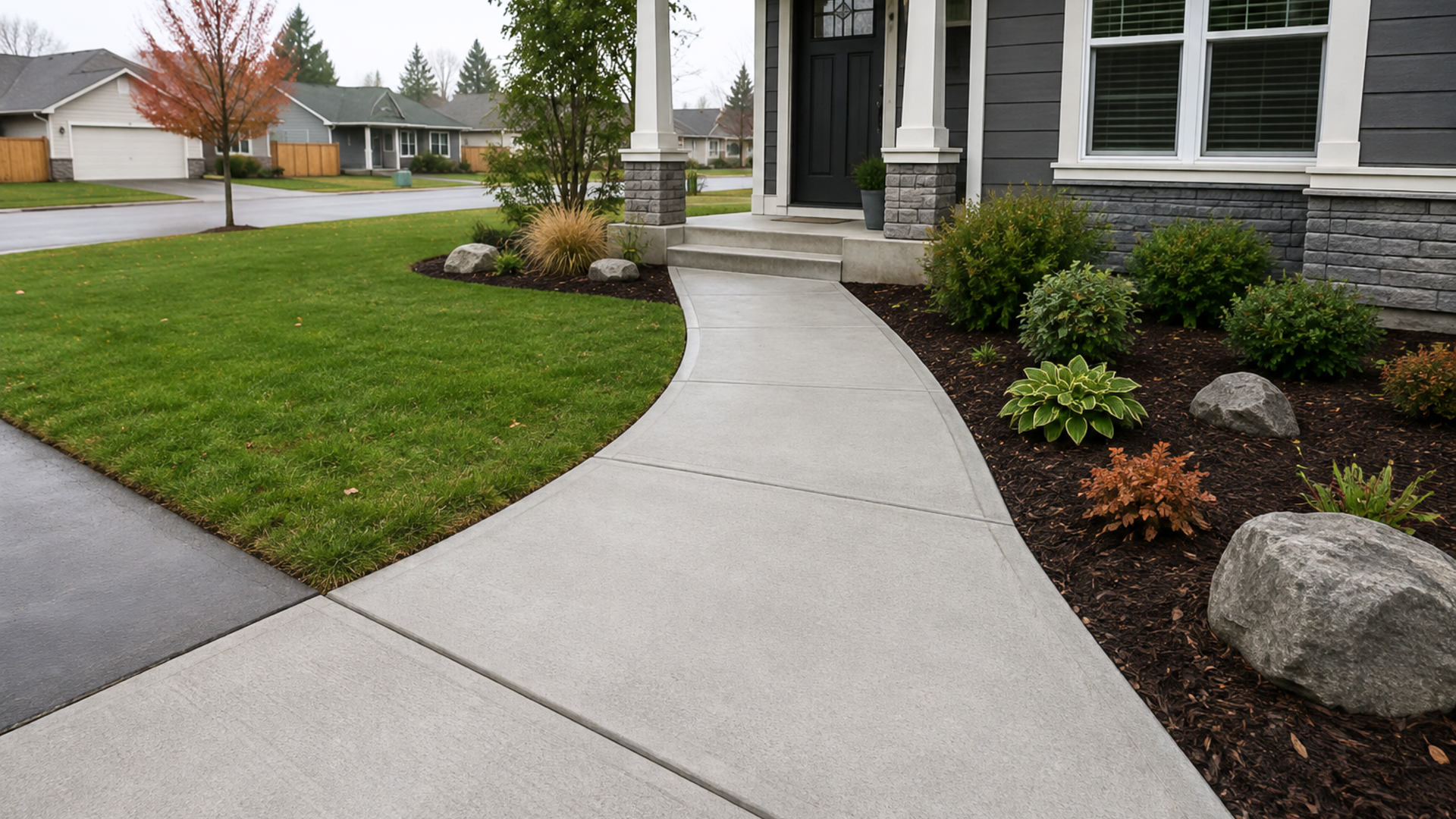
Concrete walkway cost in Vancouver depends on more than the amount of concrete being poured. The size and shape of the path matter, but so do excavation, base preparation, property access, drainage, demolition, and the finish you select. Permit requirements can also come into play when the project involves a public sidewalk or other work within the right-of-way.
For homeowners in Vancouver and Clark County, getting these details right before the pour can prevent unnecessary costs and problems later.
This guide covers concrete walkway and sidewalk costs, popular design options, installation considerations, permit requirements, and what to discuss with a concrete contractor before starting your project.
How Much Does a Concrete Walkway Cost in Vancouver?
For early budgeting, homeowners can expect a basic residential concrete walkway to generally start around $8 to $18 per square foot, while decorative or more complex projects can reach $18 to $30 or more per square foot.
These are planning ranges rather than fixed local quotes.
A small walkway can also cost more per square foot than a larger concrete project. Contractors still need to bring equipment, prepare the site, set forms, arrange concrete delivery, finish the slab, and clean up afterward. Those costs do not disappear simply because the walkway is small.
Here is a useful starting point:
| Walkway Type | Planning Cost Per Sq. Ft. | Common Use |
|---|---|---|
| Standard Broom Finish | $8–$18 | Front walks, side yards and utility paths |
| Colored Concrete | $12–$22 | Entry paths and coordinated exterior designs |
| Exposed Aggregate | $15–$25 | Textured and decorative walkways |
| Stamped Concrete | $18–$30+ | Decorative front entries and landscape paths |
| Walkway Replacement | Varies | Cracked, settled or poorly graded existing concrete |
The final estimate depends on the property. A straight walkway on level ground with easy access will usually be less complicated than a curved front path requiring old concrete removal, grading, drainage work, or decorative finishing.
What Affects Concrete Walkway Cost?
Square footage is important, but it does not tell the whole story.
When a contractor evaluates a walkway project, several conditions affect the amount of labor and material required.
Walkway Size and Width
A longer or wider walkway requires more excavation, base material, forms, concrete, and finishing.
Width is especially important because even a small change adds up over a long path.
For example, increasing a 50-foot walkway from three feet to four feet wide adds another 50 square feet to the project.
Before choosing the width, think about how the walkway will actually be used. A narrow garden path has different needs than the main route between a driveway and front door.
Existing Concrete Removal
If you are replacing an old sidewalk or walkway, the contractor may need to:
- Break and remove the existing concrete
- Haul away debris
- Excavate damaged or unstable material
- Correct the grade
- Rebuild the base
- Install new forms
Removal adds labor and disposal costs, but it also gives the contractor an opportunity to identify why the old concrete failed.
If an existing walkway has settled because the material underneath was poorly compacted, pouring a new slab without correcting the base can lead to the same problem later.
Excavation and Base Preparation
Much of the work that determines the life of a walkway happens before you ever see concrete.
The area must be excavated to the proper depth and prepared so the slab has consistent support.
Depending on the property, preparation may involve:
- Removing topsoil or soft material
- Grading the area
- Adding crushed rock or another suitable base
- Compacting the base
- Correcting drainage
- Preparing transitions to existing concrete
This is one area where comparing estimates based only on price can be misleading.
Ask what preparation is included.
If your property requires more extensive grading before concrete can be installed, excavation and site preparation may become an important part of the project.
Access to the Work Area
A front walkway beside an open driveway may be easy for a crew to reach.
A narrow side yard or backyard can be more challenging.
Restricted access may require additional hand labor, smaller equipment, wheelbarrows, or another method of getting concrete from the truck to the forms.
The farther materials and equipment need to travel, the more labor the project may require.
Walkway Shape
Straight walkways are usually easier to form.
Curved walkways require more detailed layout and forming but can work very well around landscaping, planting beds, and traditional homes.
Neither is automatically better.
The best shape is the one that creates a natural route without wasting usable yard space.
Concrete Finish
The finish can make a noticeable difference in price.
A basic broom finish requires less decorative work than stamped concrete. Decorative finishes can require additional coloring, stamping, detailing, washing, or sealing.
That added labor is why two walkways of exactly the same size can have very different prices.
What Is the Best Concrete Finish for a Walkway?
Outdoor concrete needs to balance appearance with everyday use.
Vancouver receives plenty of wet weather, so traction should be considered when selecting a walkway finish.
Here is how common options compare:
| Finish | Appearance | Traction | Maintenance | Relative Cost |
|---|---|---|---|---|
| Broom Finish | Simple and traditional | Good | Low | $ |
| Colored Concrete | Custom color with selected texture | Varies | Low to moderate | $$ |
| Exposed Aggregate | Visible stone texture | Good | Moderate | $$–$$$ |
| Stamped Concrete | Mimics stone, slate or brick | Varies by pattern | Moderate | $$$ |
Broom Finish Concrete
Broom-finished concrete is one of the most practical choices for residential walkways.
A broom is pulled across the surface while the concrete is still workable, leaving fine lines that create texture.
It works especially well for:
- Side-yard paths
- Walkways between the driveway and backyard
- Utility access
- Standard front walkways
- Paths around garages and shops
It is straightforward, functional, and relatively easy to coordinate with existing concrete.
Stamped Concrete
Stamped concrete is worth considering when the walkway is a visible part of the home's exterior design.
Patterns can recreate the general appearance of:
- Slate
- Flagstone
- Brick
- Tile
- Natural stone
Color can also be added to coordinate the walkway with the house, masonry, driveway, or landscaping.
A decorative front walkway can create visual interest without requiring you to use stamped concrete across the entire driveway.
Homeowners interested in this approach can explore stamped and decorative concrete services in Vancouver for related design options.
Exposed Aggregate
Exposed aggregate reveals some of the stone within the concrete instead of leaving a uniform cement surface.
The result has more texture and visual variation than standard concrete.
It works especially well with Northwest-style landscaping, natural stone, darker siding, and properties where homeowners want more detail without choosing a stamped pattern.
Concrete Walkway Design Ideas for Vancouver Homes
A walkway should do more than connect two points.
Its width, shape, finish, and location affect how people move around the property and how the exterior looks from the street.
Create a Wider Front Entry Walkway

The main walkway to the front door deserves more space than a basic utility path.
A wider walkway allows two people to walk comfortably together and can create a more welcoming transition between the driveway and entrance.
For larger homes, the walkway can also widen into a landing near the front steps.
Add a Curved Walkway Through Landscaping

Curved paths work well when the front or backyard includes established planting beds, trees, or other landscape features.
The curve should still create a logical route.
Too many unnecessary bends can make a walkway less convenient and increase forming costs.
Connect the Driveway to the Backyard

A concrete side-yard walkway can make everyday tasks much easier.
Instead of crossing grass or mud, you have a solid path for:
- Trash and recycling bins
- Garden equipment
- Bikes
- Outdoor furniture
- Wheelbarrows
- General backyard access
When the walkway connects directly to a driveway, matching the finish and planning the transition carefully can help both surfaces feel like one project.
If your driveway is also nearing replacement, review concrete driveway installation in Vancouver before deciding whether to complete both projects together.
Connect the Walkway to a Patio

Walkways are also useful for connecting front and backyard spaces.
If you are already considering a patio, installing the walkway as part of the same project may allow the contractor to coordinate elevations, finish, drainage, concrete delivery, and joint placement.
See concrete patio installation in Vancouver if your walkway will become part of a larger outdoor living project.
Use Decorative Concrete Around the Front Entrance

Decorative concrete does not have to cover every square foot of the property.
A stamped or colored walkway can serve as an accent between a standard concrete driveway and the front door.
This approach gives the entrance more detail without paying for a decorative finish across a much larger driveway.
How Wide Should a Concrete Walkway Be?
There is no single width that works for every private residential walkway.
A useful planning guide is:
| Walkway Use | Practical Planning Width |
|---|---|
| Garden Path | 2.5–3 ft |
| Side-Yard Access | 3–4 ft |
| Main Front Walkway | 4–5 ft |
| High-Traffic Entry Path | 5+ ft |
These are design guidelines, not universal permit or code requirements.
Think about what will move through the space.
A three-foot path may be enough for occasional access. A primary entrance may feel much more comfortable at four or five feet.
If you regularly move trash bins, strollers, garden carts, or other equipment through the area, plan around those needs before the forms are installed.
Concrete Walkway vs Sidewalk: What Is the Difference?
Homeowners often use "walkway" and "sidewalk" to describe the same thing, but there is an important distinction when permits are involved.
A private walkway generally refers to a path located entirely on your property, such as:
- Driveway to front door
- House to backyard
- Side-yard access
- Garden path
- Patio connection
A public sidewalk is typically located along the street within or affecting the public right-of-way.
That distinction matters because work in the public right-of-way may require permits and approved contractors even when a simple private walkway does not.
Do You Need a Permit for a Concrete Walkway in Vancouver?
Whether you need a permit depends primarily on where the work is located and what is being changed.
Private Walkways
A simple ground-level concrete walkway located entirely on private property is different from sidewalk work within the public right-of-way.
Permit requirements can still depend on the property and scope, so homeowners should verify requirements before construction if there is any uncertainty.
Public Sidewalk Replacement in Vancouver
If the project involves replacing sidewalk within the City of Vancouver public right-of-way, a Right-of-Way Permit is required.
The City also requires contractors performing this type of right-of-way work to be authorized to work within Vancouver's public right-of-way.
Some limited sidewalk repairs, such as certain grinding or patching work, may be treated differently from full replacement.
Sidewalk Work in Unincorporated Clark County
Outside Vancouver city limits, the applicable jurisdiction may be Clark County or another municipality.
Clark County uses an Approach/Sidewalk Permit (APS) for work that includes sidewalk repair or replacement and certain road approach projects.
Clark County also notes that patio and concrete slabs at ground level can be exempt from a residential building permit in some circumstances, although the work still needs to comply with applicable requirements and cannot simply be placed over easements.
The important takeaway is simple:
Do not assume every concrete walkway needs a permit, and do not assume sidewalk replacement is automatically permit-free.
Confirm the jurisdiction and whether the project affects public right-of-way before work begins.
What Should Be Included in a Concrete Walkway Estimate?
Do not compare contractors using the final number alone.
Ask what the estimate actually includes.
A useful estimate should address items such as:
- Demolition, if needed
- Concrete disposal
- Excavation
- Base preparation
- Compaction
- Concrete thickness
- Reinforcement, when applicable
- Finish
- Control joints
- Drainage considerations
- Cleanup
- Permit responsibilities, if required
If one estimate is significantly cheaper, determine whether the scope is actually the same.
The quality of work underneath the concrete can matter just as much as the finish you see when the project is complete.
How to Choose a Concrete Contractor in Vancouver
Concrete walkway installation looks simple when you only see the finished slab.
In reality, a good project requires careful preparation and timing.
When speaking with a contractor, ask:
- How will you prepare and compact the base?
- How thick will the concrete be?
- How will the walkway drain?
- What finish do you recommend for this location?
- Where will the control joints go?
- Is reinforcement recommended?
- Who handles permit requirements if they apply?
- Is demolition and disposal included?
- What is the expected project timeline?
- What workmanship warranty is provided?
A contractor should be able to explain why a certain approach makes sense for your property rather than simply giving you a square-foot price.
Planning Your Concrete Walkway Project
Before requesting an estimate, spend a few minutes walking the route yourself.
Think about how your household actually moves through the property.
Consider:
- Where the walkway should start and end
- How wide it should be
- Whether a straight or curved layout makes more sense
- How it will meet the driveway or patio
- Where water currently flows
- Whether landscaping will change
- Whether you want decorative concrete
- Whether another concrete project is planned soon
- Whether any part of the work reaches the public sidewalk or right-of-way
Those decisions can make the estimate more accurate and help avoid changes once construction starts.
Frequently Asked Questions About Concrete Walkways in Vancouver
How Much Does a Concrete Walkway Cost in Vancouver, WA?
For early budgeting, a standard residential concrete walkway may fall around $8 to $18 per square foot, while decorative finishes and more complicated installations can cost more. Size, access, demolition, excavation, base preparation, finish, and site conditions all affect the final estimate.
Do I Need a Permit for a Concrete Walkway in Vancouver?
A private ground-level walkway is different from work within the public right-of-way. In Vancouver, sidewalk replacement within the public right-of-way requires a Right-of-Way Permit. Verify requirements for your specific property before beginning work.
What Is the Best Finish for a Concrete Walkway?
Broom finish concrete is a practical choice for many outdoor walkways because it provides texture and requires relatively little maintenance. Stamped concrete, exposed aggregate, and colored concrete provide more decorative alternatives.
How Wide Should a Residential Concrete Walkway Be?
A side-yard path is often around three to four feet wide, while a main front walkway may be more comfortable around four to five feet wide. The best dimension depends on how the path will be used and any applicable local requirements.
How Thick Should a Concrete Walkway Be?
Pedestrian concrete walkways are commonly around four inches thick. The appropriate thickness and reinforcement depend on soil conditions, base preparation, drainage, and whether the area will experience heavier loads.
How Long Does a Concrete Walkway Last?
A well-installed concrete walkway can remain functional for decades. Its lifespan depends on base preparation, drainage, concrete quality, curing, soil movement, tree roots, weather exposure, and maintenance.
Get a Concrete Walkway Estimate in Vancouver, WA
Concrete walkway cost in Vancouver depends on the size of the project, but square footage is only the beginning. Excavation, base preparation, drainage, access, demolition, finish, and permit requirements can all affect the final scope and price.
A simple broom-finished side-yard path may need little decorative work. A front entry walkway may benefit from additional width, curves, color, or stamped concrete. Public sidewalk replacement may also require permits that do not apply to a private walkway.
Clark County Concrete provides residential concrete services throughout Vancouver and surrounding Clark County communities, including Camas, Ridgefield, Battle Ground, Washougal, and La Center.
If you are planning a new walkway, replacing damaged concrete, or coordinating the project with a driveway or patio, contact Clark County Concrete to request an estimate and discuss the best approach for your property.